L.C. Smith Field Grade Twenty-Gauge
L.C. Smith shotguns are well known and revered by side x side connoisseurs. However, for those who may be unfamiliar with the long, storied history of the company below is a timeline:
W.H. Baker Company
1877 W.H. Baker and Company started making the Baker Three-Barrel Gun in Lisle, NY.
1879 W.H. Baker forms a partnership with L.H. Smith and L.C. Smith and manufactures the Baker Three-Barrel Gun in Syracuse, NY.
1880 W.H. Baker and L.H. Smith leave the company and Lyman Cornelius Smith (1850-1910) takes over the company.
L.C. Smith, Maker of the Baker Gun
1881 An advertisement listed the product as “The Baker Guns, L.C. Smith Maker, Syracuse, N.Y.”
1884 Began manufacture of L.C. Smith double barrel hammer guns in qualities F ($55), E ($70), D ($95), C ($125), B ($150), A ($200), and AA ($300).
1886 L.C. Smith hammerless guns were introduced in Qualities 2 ($80) through 7 ($450).
1888 Manufacture of the Baker Three-Barrel guns ceased. L.C. Smith sold the company to John Hunter, Sr., Fulton, NY and founded the L.C. Smith and Brothers Typewriter Company.
Hunter Arms Company
1888 John Hunter Sr. bought the L.C. Smith Gun Co. It was his intention to have a business in which his six sons could work together, and so the Hunter Arms Company was established. 1889 Hunter Arms Company completed a factory in Fulton, NY to build the L.C. Smith gun.
1892 Automatic ejectors were available. Qualities 1 through 5 and Grades Monogram, A1, A2, and A3 were offered.
1895 The Pigeon Gun ($125), No.1 Grade ($60), and No. 0 Grade ($42) were added.
1898 The No. 00 Grade was added.
1904 The Hunter One-Trigger was available.
1908 Featherweight guns were offered.
1913 Names, grades, and engraving patterns were changed to Field, Ideal, Trap, Specialty, Eagle, Crown, Monogram, Premier, and De Luxe.
1917 Ownership of the company changed to a group of Fulton citizens. A One-Barrel Trap gun and vent rib on the single barrel were introduced.
1920 The Hunter Arms Company was purchased by Gifford K., A.T., and H.K. Simonds of Fitchburg, MA.
1924 The Long-Range Wild Fowl gun was introduced.
1925 Vent Ribs were introduced as an option on double barrel guns.
1929 The Skeet Grade was offered.
L.C. Smith Gun Company
1945 The company was purchased by Marlin Firearms Company, North Haven, CT. The L.C. Smith Gun Company was organized as a subsidiary company to continue production of the L.C. Smith shotgun.
1949 A section of the first floor of the factory in Fulton collapsed causing nearly complete suspension of manufacturing.
1950 The factory was closed.
My Elsie
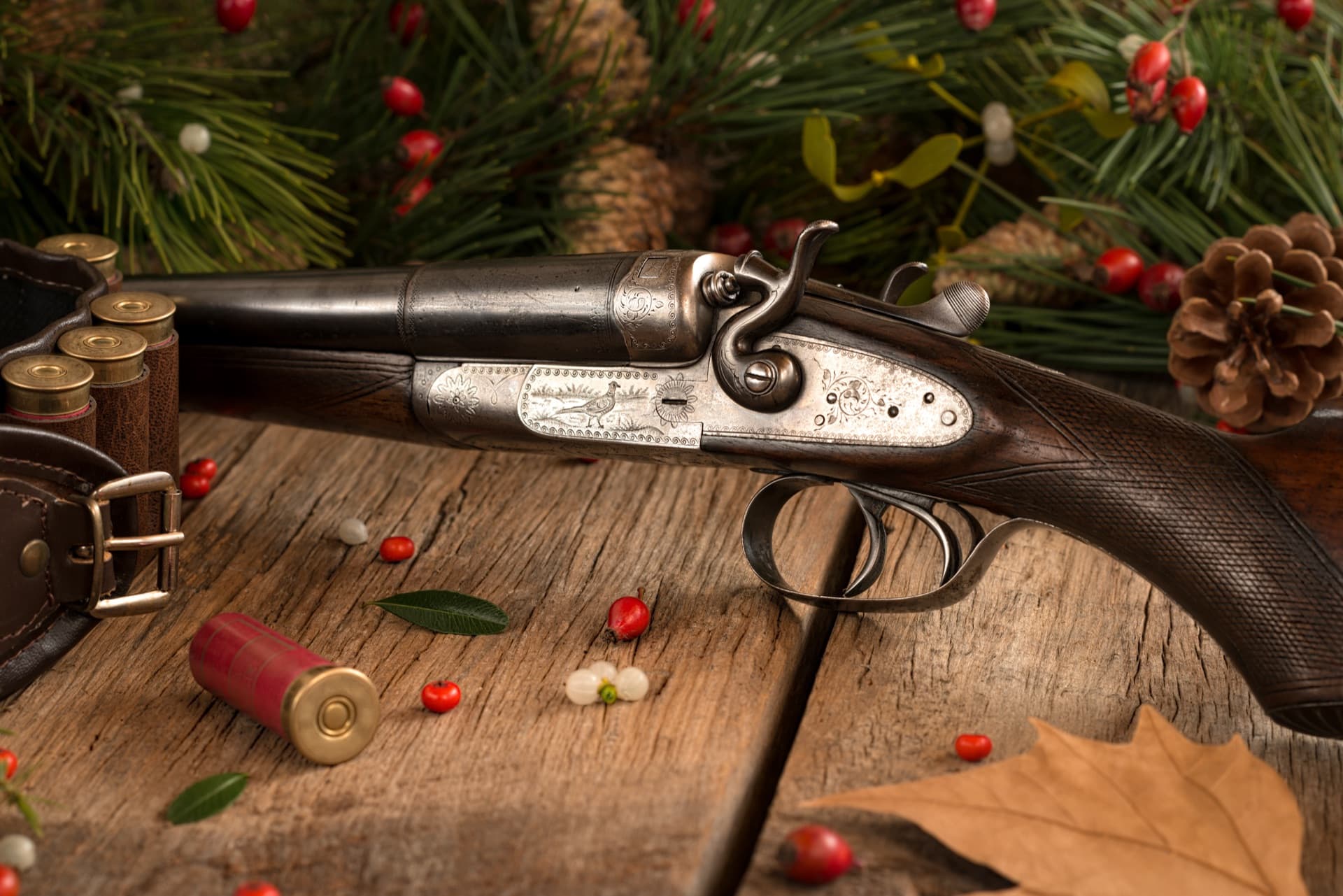
I inherited my L.C. Smith twenty-gauge shotgun from my father upon his passing. It’s a Field Grade with 28-inch barrels that was manufactured by Hunter Arms in 1919. It has double triggers and is choked Improved Modified (right barrel) and Full (left barrel) as was common during this era. The base price of a twenty-gauge in 1919 was $35.00 to $45.00 ($655.00 to $840.00 in 2026 dollars).
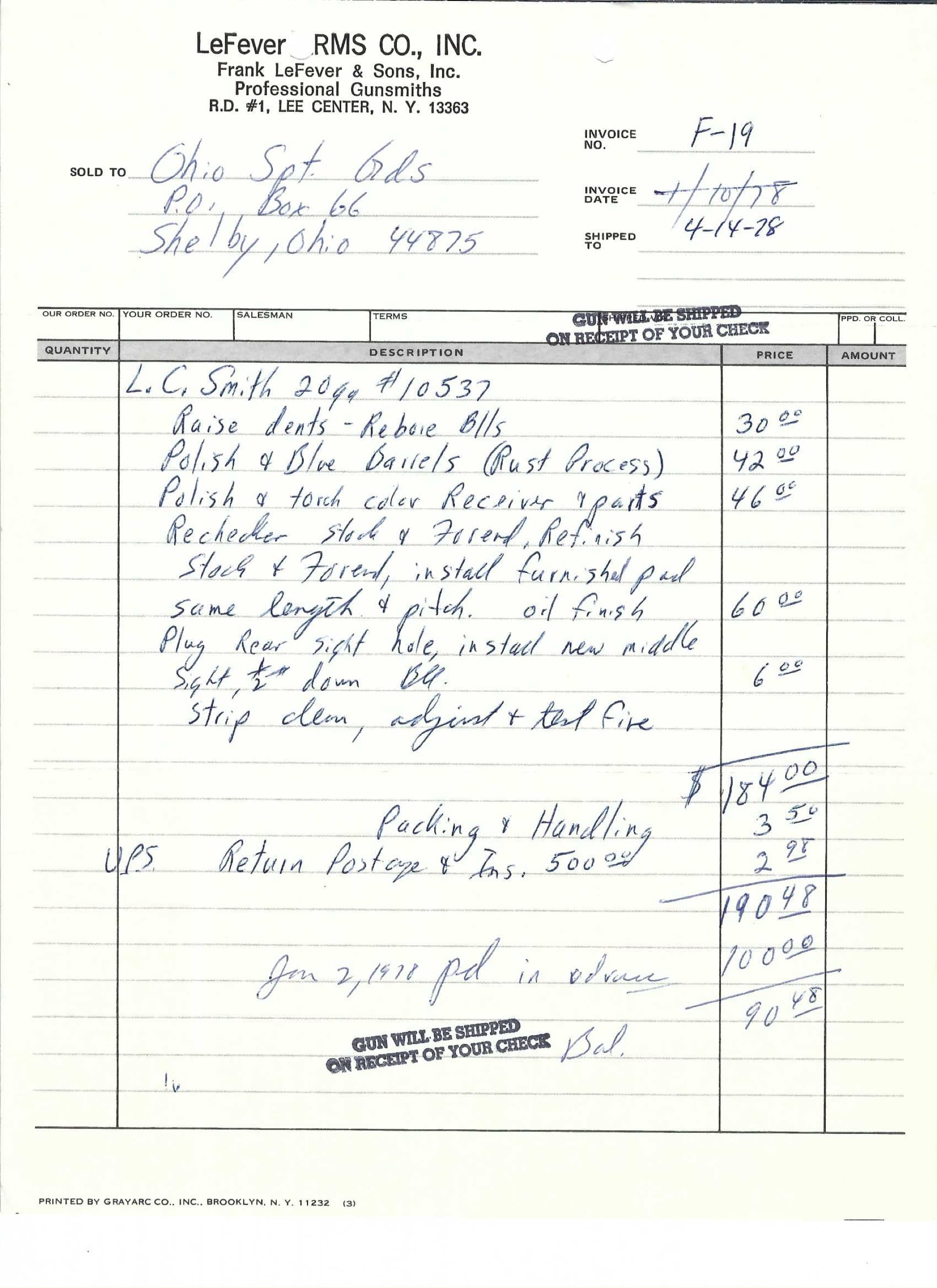
I never saw it in the condition it was in when my father obtained it, but apparently it required some refurbishing. In January 1978, he sent it to LeFever Arms Company in Lee Center, New York for an estimate of the repairs along with some other suggestions and requests for its reconditioning. LeFever Arms recommended raising dents and reboring the barrels combined with a polish and re-blue. They also suggested that the receiver be polished and recolored along with other small parts. Finally, they wanted to re-checker the original stock and forearm. A White Line recoil pad was installed.
There were some additional recommendations as indicated in their estimate. Apparently making a new beaver tail style forearm as requested by my father was not accomplished. The total refurbishment and minor repairs in 1978 totaled $184.00. That’s the equivalent of $914.00 in 2026.
The end result is a very nice, gently restored L.C. Smith. I’ve had it out in the field a couple of times, but I don’t want to expose it to heavy brush or elements. I’ve also taken it to a local pheasant preserve when I’m in the mood to shoot a side-by-side with double triggers. It always takes a little while to get reacquainted with switching from one trigger to the other.
L.C. Smith stands as one of the most well-regarded American made shotguns during the golden age of American shotgun manufacturing. To this day, collectors and side-by-side aficionados alike revere the Sweet Elsies as elegant representations of what an American double-gun should be. While my Elsie is not a safe queen, she only finds herself in the field on special occasions. Its like taking a walk with an old friend.