The concept of beauty is so subjective that artists, poets, and architects have abandoned traditional wisdom and methodology countless times in pursuit of it. From Pablo Picasso’s Les Demoiselles d’Avignon to Frank Lloyd Wright’s Pennsylvania masterpiece, Falling Water, the limits of what is both possible, and beautiful has been challenged to a significant degree by those in pursuit of perfection. So is the case with the Scottish Round-Action. A design so svelte and sophisticated that it’s inconceivable such a design originated in 1879 and has remained little improved since then.
Subtitle: History of the Scottish Round-Action Gunmakers
To set the scene, the Victorian era in Scotland was a time of great wealth and success, for the affluent in society. Sport shooting was one of the most popular sports of the time, particularly grouse shooting. The quarry was Red Grouse, a bird that is capable of airspeeds reaching 70 miles per hour, and agile enough to negotiate aerial maneuvers which would humble the finest F-22 Raptor pilot. The challenge presented for a shooter, by these astounding avians, is further complicated by a heavy, bulky double gun. Yet just another instance where necessity becomes the mother of invention.
There may be debate on who produced the “first” Round-Action, but conventional wisdom is two of Scotland’s finest developed the design somewhat simultaneously. Both hailing from the grand city of Edinburgh, the firms of James MacNaughton & Sons and John Dickson & Son produced the first true Round-Action shotguns. The impetus for this design was, without a doubt, a desire to increase efficiency on the heather moorlands of the Red Grouse.
In the Beginning
The journey from concept to reality was rooted in dialogue, originating from a German-born gunmaker from the Alexander Henry firm, named Julius Coster. Julius spoke of his father, a gunmaker in Germany, who had developed and was producing guns with trigger-plate actions. In a departure from the sidelocks and box locks employed by the London guns, the trigger-plate action places the hammers, sear, and springs directly above the trigger as opposed to within the receiver. This innovation requires far less metal removal from the interior of the receiver in order to house the action, while simultaneously permitting significant exterior metal removal. Removal of the excess metal allows for the receiver to be shaped into a rounded profile, while maintaining great integrity in terms of strength. The result of this technical masterpiece was a handsome, aesthetically appealing double gun which placed the majority of the weight of the shotgun in a central plane and in between the hands of a shooter. The ultimate balance for a swiftly moving smoothbore had been achieved.
James MacNaughton and Sons
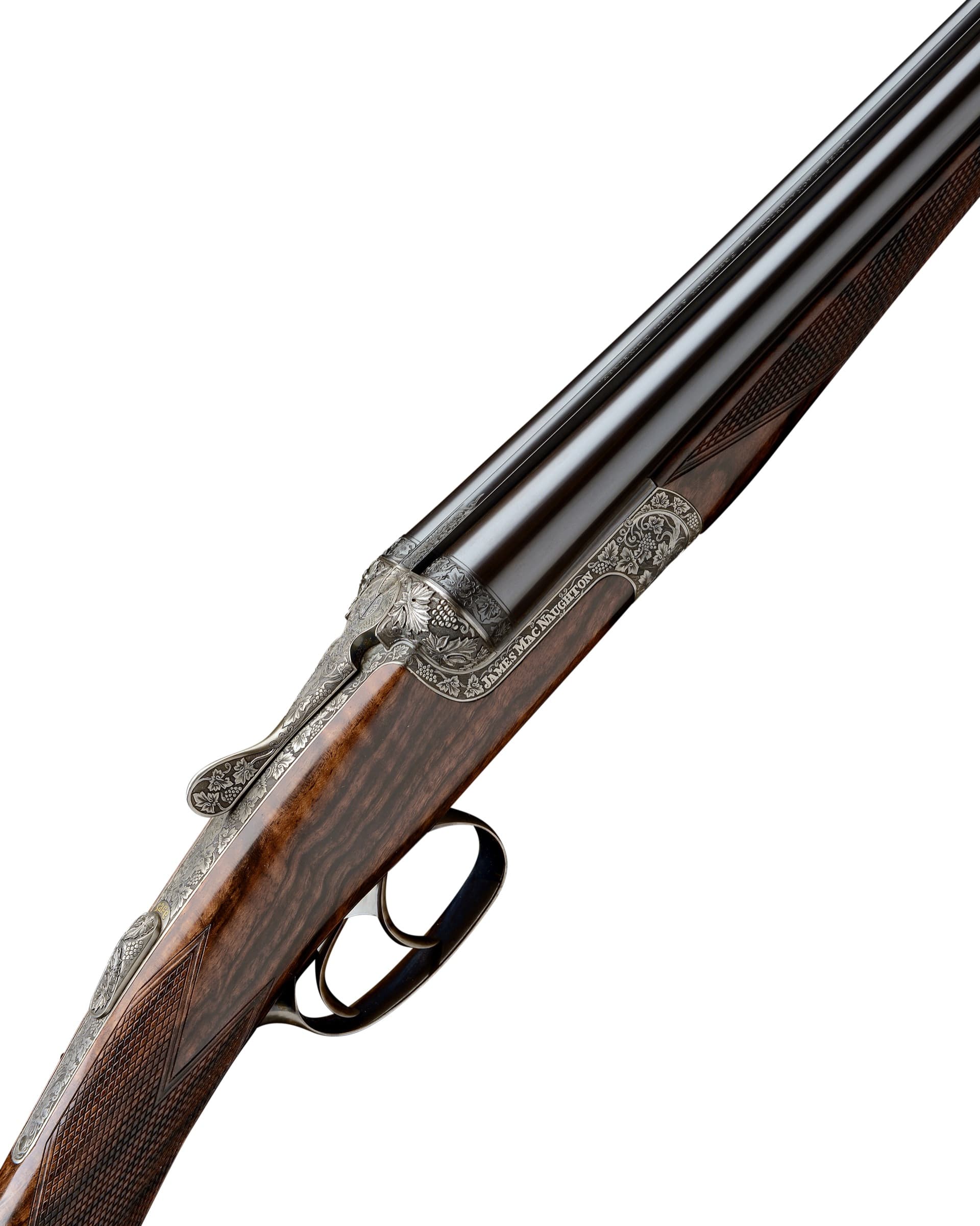
On July 12th, 1879, a former apprentice of the Dickson & Son firm, James MacNaughton, was granted patent number 2848 for a new gun mechanism. This would mark the very first patent for a true Round-Action shotgun. The revolutionary design, dubbed the “Edinburgh Gun”, utilized a trigger plate mechanism, and incorporated a cocking system which used the force of the top lever articulation to set the locks – a ‘lever cocker’ system.
As gun development was moving from hammer to hammerless, these initial MacNaughton guns came supplied with a crystal inspection window in the top strap, making it visually possible to determine what position the internal hammers were in.
From the start of the production, MacNaughton introduced a variant which would really set his gun apart from others. Adopting the ‘bar-in-wood’ build that graced classic London sidelocks and hammer guns, MacNaughton would machine the action exterior and continue the wood up to the knuckle of the gun. This would be MacNaughton’s ‘Skeleton’ gun, with the wood removed, the action looked like a skeleton, and it would be his flagship Edinburgh gun.
The MacNaughton Round-Action gun is considered a “best” gun, being produced in very low quantities compared to other manufacturers. In 1905, after the death of the MacNaughton patriarch, the firm was continued by James’ sons until 1947 when John Dickson & Son acquired the rights to the MacNaughton name and continues to produce the “Edinburgh Skeleton Gun” to this very day. However, less than a year after MacNaughton first received his patent, the firm of John Dickson & Son upped the ante with a patent for a trigger plate action gun but also incorporating a new cocking slide mechanism. There was a rumor of court action over patent infringement, but this is nothing more than a myth. MacNaughton, respectful of this former master, Dickson respectful of his excellent former apprentice. MacNaughton would also later replace his ‘lever cocker’ system with the more efficient Dickson’s 1880 cocking slide patent, again with no bad words between the master gun makers.
John Dickson & Son
John Dickson, a former apprentice, and the foreman of the renowned Edinburgh gunmaker, James Wallace, started his business in 1820, alongside his son, John II, in the back of Wallace’s premises. Their first shop, John Dickson & Son, opened in 1838 on the grand thoroughfare of Princes Street, a presence they would hold for the next 100 years. John and his son soon built up a great reputation for innovation and makers of finest quality guns and rifles only. Of the nine children John II and his wife raised, their two eldest sons showed interest in the business and became apprentices to their father.
The concept for the Dickson Round-Action manifested and was seen through to fruition under the tutelage of John III and a patent covering a cocking slide and partial triggerplate action was filed in 1880. This was followed by patents covering the triggerplate design in 1882 and an assisted opening/ejector system in 1887/1889. Upon the death of John II, the firm was taken over by his sons Peter and John III, who continued to run the firm producing best quality guns and rifles until Peter’s sudden death in 1892, leaving John III to continue the legacy of firm. The Dickson Round-Action was a success from the start, every accomplished businessman or significant landowner in Scotland owning at least one. The order books full of the names of prominent Scottish Lords, men of Science, Engineering and Law, who all enjoyed driven grouse shooting. In 1903, considered part of the ‘golden years’ of production, Dickson’s delivered 85 Round-Actions, each one, a best quality gun.
Dickson continued as an independent gunmaker until 1923 when, with no heirs interested in the business, John III sold the company to a local businessman, Alexander Prain. A series of mergers and acquisitions dot the history of Dickson & Son, but it would be 96 years before Dickson’s was back in the hands of a real gun maker. In 2019, the firm was acquired by J-P Daeschler, a best gun maker in his own right and Dickson specialist, and they continue to build the bespoke Dickson and MacNaughton shotguns in a time-honored fashion in Scotland.
David McKay Brown
When compared to Dickson and MacNaughton, David McKay Brown is a relative newcomer to the Scottish Round-Action game. Having apprenticed under John Dickson & Son until 1967, McKay Brown ventured out on his own, setting up shop near Glasgow. The business started with repairs and gun making for other manufacturers, Dickson included, but McKay Brown eventually brought out a Dickson Round-Action under his own name in 1974. In 1992, David McKay Brown introduced an exquisite Round-Action over-under shotgun which immediately drew praise and admiration from discerning sportsmen everywhere.
McKay Brown has maintained the highest of quality standards and continues to produce “best” quality guns at their factory to this day. The company is currently in the very capable hands of Grant Buchan, whose leadership has maintained McKay Brown’s reputation and prestige in the industry.
Design Details
The Scottish Round-Action has numerous unique and novel features within the design of the action itself. Firstly, as opposed to using leaf springs, this action opts for long bow springs with the aid of a roller bearing which provides an ease of cocking and maximum blow on release. The hammers, cocking levers, sears, main springs, and safety mechanism are mounted centrally on the trigger plate, while sharing some springs and components and reducing the overall part count and reduction in weight. The gun also has the ejector and assisted opening system housed in the action body allowing the fore-end to continue the roundness through the gun. These innovations are a drastic departure from the sidelock and the boxlock, which either house a lock in a side-plate or entirely within a lengthened receiver on a box lock.
With nothing more than the ejector or extractor components needing to pass through the receiver, a significant amount of metal can be removed from the outer surface of the receiver without compromising the structural integrity. This ingenious design has remained largely unchanged since its introduction in 1880, and no other firms have attempted to copy it.
An Enduring Legacy
Many would argue the Scottish Round-Action is not only the most elegant, but also one of the most cleverly conceived side by side actions of all time. Perfect balance, beautiful lines, a swift barrel, and superb precision craftsmanship situates the Round-Action as the Bugatti of double guns. These three manufacturers only produce bespoke, “best” quality firearms. All are still in production in quite low numbers. To date, less than 3000 total Round-Actions have been produced by all three gunmakers combined. Visionaries and highly skilled craftsmen have worked tirelessly to maintain, not only the quality, but the relevance of the Scottish Round-Action in the current market. When it comes to grouse shooting on the moors of Scotland, not a more sophisticated and purpose-built double gun has ever been created.