King Buck-The Dog Who Defied Death and Doubters to Become the Most Decorated National Field Trial Champion in History
My curated visit to Nilo piqued my curiosity and stretched my imagination. Every hour of the visit opened new doors revealing new stories, new ideas, new firsts, and innovative thinking. This very special invitation only opportunity for a backstage tour of John Olin’s personal hunting grounds, wildlife preserves and conservancy, is the courtesy of Nathan Robinson, Marketing Manager for Winchester Ammunition and Nilo’s boot’s-on-ground manager, Duane Pitts.
John M. Olin, by all measures an iconic man, was unique and fixated on the future. His personal motto was, “There’s always a better way to do anything, if you will put your mind to work.” Olin was an inventor or co-inventor of 24 United States patents in the field of arms and ammunition design and manufacture.
John M. Olin propagated his personal motto with the Olin Business School and the Olin Library at Washington University in St. Louis, the Olin Library at Cornell University, Olin Hall at Johns Hopkins University, and Olin-Sang Hall at Brandeis University. Clearly, Olin was a man who believed in the power of a well-developed mind and the training required to leverage its most powerful gifts.
John M. Olin is more than the leader of Winchester Ammunition and the Chairman of Olin Corporation, he is the man who could see the future and wanted to embrace and promote nature and the land. Today, Nilo (Olin backwards) Farms and Kennel remains a testament to a great visionary man who was constantly learning and giving back.
Traveling to NILO Farms is sampling the agricultural Midwest; Silos the size of Chicago skyscrapers, modest farmhouses, well-maintained barns, and lots of pickup trucks. As I pull into Nilo, I am struck by its modesty, and its order.
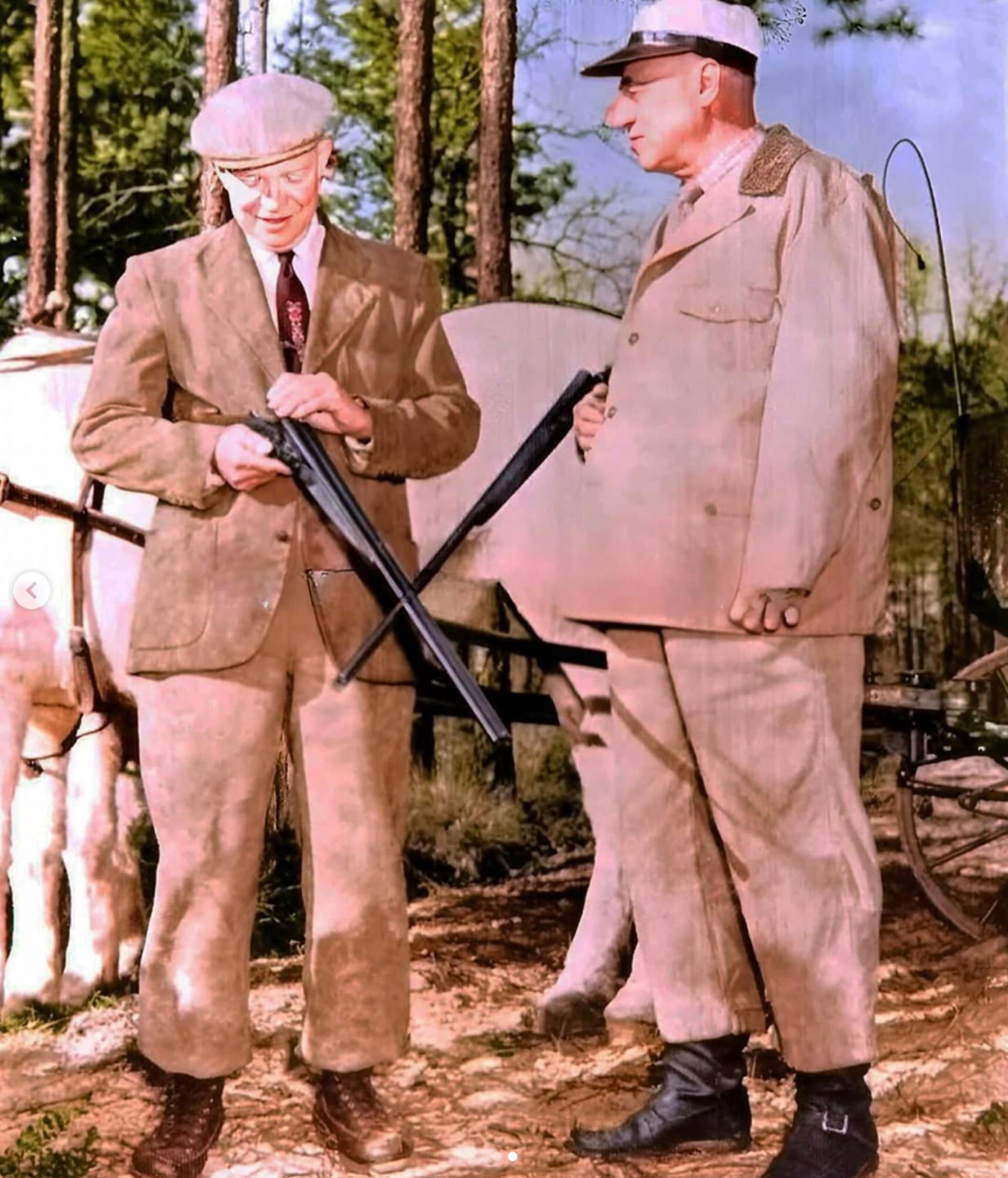
I join Nathan Robinson, Marketing Manager for Winchester Ammunition, accompanied by Duane Pitts in the modest white farmhouse adorned with brown trim and shutters. It feels like stepping back in time when small spaces and warm wood tones brought a sense of security and conviviality, catalyzing fervent sharing and deep bonding. Every wall is lined with photos, plaques, awards and memorabilia chronicling the story of the farm’s journey under the leadership of Mr. Olin; iconic Winchester Ammunition, the world-famous 2-Time National Field Trial Champion, King Buck; and T. W. "Cotton" Pershall…Head Trainer of King Buck and his legacy of pups.
Although each room in this modest clubhouse is as you might expect frozen in time from the 50s and 60s, the trophy room is stunning and timeless. The volume of trophies renders the viewer unable to fathom the commitment, tireless work and raw talent required to achieve the accomplishments necessary to fill this room from floor-to-ceiling with a plethora of silver trophies. One can only be humbled amid such greatness.
Field and Stream studied and documented the world’s most legendary hunting and National Field Trial dogs throughout history and ranked King Buck and Shadow Oak Bo, an English Setter, as the only two dogs, since the inaugural first championship in 1896, to ever win two National Field Trial Championships …this puts King Buck’s elaborate trophy room in better context as I try to wrap my mind around his life.
Hard to believe this small stature Black Labrador Retriever, who nearly died in his first year from distemper, would be selected by John M. Olin on a hunch that the dog had potential. Olin put great priority on the power of the mind, and it turned out King Buck was one of the smartest and most determined field trial dogs the world would ever witness.
Olin's passion for Labradors began in the 1940s, when W. Averell Harriman, Secretary of State under Franklin Delano Roosevelt, introduced Olin to Labrador retrievers. The devotion and dedication of Harriman and Olin to Labradors not only promoted the breed to American sportsman, but advanced field trial competition and selective breeding.
“There’s always a better way to do anything, if you will put your mind to work.”
King Buck seemed to have some power of knowing the competition, and always came through, winning trial after trial. T. W. "Cotton" Pershall said, “King Buck was the first Labrador to win back-to-back national championships in 1952 and 1953, establishing a still-standing record by completing 83 national championship series out of a possible 85…a record unprecedented.
Of all the stars and celebrities who graced the grounds of Nilo Farms, no one could have imagined this modest black dog would be the one to make this kennel legendary and world renowned.
Located just 12 miles north of Winchester Ammunition and Olin headquarters in East Alton, Illinois lies 600-acres of gently rolling hunting preserve and conservancy, featuring hardwood forest, fertile cropland, and most importantly, the site of important leadership for sportsmen and state game agencies regarding planting and maintaining wildlife habitat for a variety of species…This is Nilo Farm and Kennels, the home of John M. Olin and King Buck.
King Buck’s life is atypical and an amazing journey worth noting. King Buck was initially sold along with his brother to families in Omaha. Both young Labs were shipped to Council Bluffs where they were delivered to their new owners and taken to a well-known Omaha kennel for a few days. Supposedly, the two puppies were immunized for rabies, hepatitis and distemper before beginning their journey, but within a few days of their arrival in Omaha, both developed acute symptoms of distemper. King Buck’s brother pup was taken to a veterinarian, where he died. King Buck, near death, was placed in a basket by the basement furnace.
The little retriever showed no improvement, and its new owner was advised several times to have him euthanized. For nearly a month the pup appeared near-death. When the owner went into the basement each morning and evening, the puppy was too weak to stand. It seemed unfathomable, he was still alive.
The owner’s wife tended the puppy almost constantly, making certain King Buck was warm. Occasionally, she was successful in feeding him an egg. For weeks the small sickly Labrador clung to life with a remarkable persistence: never growing stronger, nor backsliding. He valiantly held the line of his desperate battle.
One night during a visit to the basement furnace, the pup managed to weakly stand in his basket and greet his visitor. The owner’s tears flowed freely as hope appeared for the little guy.
Soon after, with the puppy on the mend and able to take light exercise, his owner, acting on the optimistic hunch the convalescing puppy might someday rank high in his class, christened him King Buck. No one could know it was a prophecy.
Unfortunately, King Buck’s nightmare clung tight to the young dog. He did not eat well, was very thin, and released bloody stools. When examined by the veterinarian, the owner was told King Buck’s bout with distemper left its mark on the young dog: a bad heart, likely intestinal damage, and possibly damaged eyesight…this dog is not well and should not be run in the field.
The owner left the veterinarian’s office confused. King Buck survived a near death youth, was still sickly but seemingly on the mend. Despite these inarguable facts, the dog seemed to want to run in the field. The owner knew he was bred for the field and decided to let the young dog decide his future, not the veterinarian.
By the time King Buck was eighteen months old, his weight and appetite improved. In his second autumn he engaged his first real field hunting. It was clear King Buck was smart, determined and capable. He won his first licensed derby at 18 months old. This was followed by first place in September 1949, at the Missouri Valley Hunt Club’s licensed trial in Iowa and placement in numerous other derbies as he gained experience, improved health and self-confidence.
Clearly, King Buck possessed the spark of greatness which seemed fanned by each field trial. The dog’s current owner was a man of modest means and knew King Buck could be bound for global greatness if owned by a man of means who could expose the pup to world-class training and the world’s biggest and most prestigious field trials.
With a heavy heart, the current owner sold King Buck and thereby opened doors which were only available to men of means and vision. The young Labrador continued to improve, winning numerous additional field trials in commanding fashion and gaining national attention.
One of the men monitoring King Buck’s rise was John M. Olin of Alton, Illinois – founder of the Nilo Farms and Kennels. Olin was on the lookout for retrievers to stock his new kennel, and although he never witnessed King Buck in action, he believed the young dog had further potential.
Two months after King Buck’s third birthday, he was delivered to Nilo manager T. W. “Cotton” Pershall. Pershall had frank misgivings about this dog. After all, King Buck was sold as a puppy for only $50 and was plagued by a near-fatal bout of distemper, which could have left his health permanently scarred. Despite Cotton’s objections, John M. Olin had a hunch that this little dog could be bound for greatness if someone just believed in him and showed him the way. Olin adamantly overruled Cotton and paid a record $6,500 for this $50 dog despite Cotton’s misgivings.
John M. Olin believed the pieces were falling in place. King Buck now had a master of means who believed in the potential with every fiber of his being, and a world-class trainer, T.W. “Cotton” Pershall, a maker of champions. Olin hired Cotton, moved him from Minnesota to Illinois and built him a house at Nilo because, in Olin’s opinion, Cotton was the best trainer of retrievers in the nation. Cotton coached retrievers to five national titles and Olin was certain King Buck was a champion in the making. Sure enough, under Cotton’s expert hand, the maturing retriever caught fire.
In spring 1951, King Buck won a first, two seconds and a third place. That fall he took another first, a third and a fourth, and completed ten of eleven series of the 1951 National Championship Stake – placing high among the nation’s top retrievers. He made a slow start in 1952 with a first and a third in the spring. In autumn he won first, second and fourth. In November he again entered the world series of retrievers at Weldon Spring, Missouri.
The Weldon Spring National ran three days in late November and King Buck had his work cut out for him: of the thirty-two dogs entered, only one was dropped in the first six series of the grueling contest. Predictably, King Buck never gave up. He was a fighter and always doubled down when it counted most.
King Buck seemed to have some power of knowing when the competition was tough, and he always came through. Cotton Pershall said later, “He wasn’t a big dog as Labs go, but he had great style. Always quiet and well-behaved, not excitable nor flashy. He just went steadily ahead with his job, series after series, whether on land or water.”
King Buck put on a show at Weldon Spring. He obeyed superbly, responded sharply to commands, and made direct, perfect retrieves. Right down to the final test, he completed the tenth series with a 225-yard water retrieve. He was never sharper, and although it wasn’t a one-dog trial in any sense, there was never really any serious doubt of the outcome after the first few series. At the beginning of the trial King Buck was just another dog in the pack. Three days later, he was officially the finest field trial retriever in the nation.
Of a possible 300 points, King Buck earned 294.9. The judges were overwhelmed, “In all my experience, King Buck gave the best performance throughout the trial that I have ever seen.”
Another judge, Lewis E. Pierson, Jr. of Waterbury, Connecticut, wrote: “In eleven out of twelve series King Buck was faultless in every department on land and in the water - marking, bird sense, manners, steadiness, and control near-at-hand and far-out. It was so apparent to all by the twelfth series that King Buck was the clear and decisive winner that I am sure the official announcement came as an anticlimax.”
King Buck was active in the national field trial campaigns for four additional years competing against younger dogs and established champions. No other retriever in history has ever completed 63 consecutive series in the National Championship Stake. King Buck retired with a brilliant record of 83 completed series of a possible total of 85 series in national championship competition, including two successive national crowns. This dog was truly special, and John M. Olin initially saw what others could not envision from this small black lab with a heart the size of Nilo Farms.
There are too many King Buck titles and trophies to list here; as I said, the King Buck trophy room at Nilo Farms speaks for itself and will blow your mind.
For many athletes, their celebrity ends at retirement unless your name is Michael Jordon or King Buck.
Like Michael Jordon, King Buck was truly unique, self-confident and able to find another gear when the competition closed in around him, demanding an extraordinary performance to gain the victory.
Although retired, Michael Jordon is globally known for his athletic performance, records, accolades, and his ability to predictably win…this is the Air Jordon legacy and the global brand which makes Michael Jordon as relevant today as he was during his playing career.
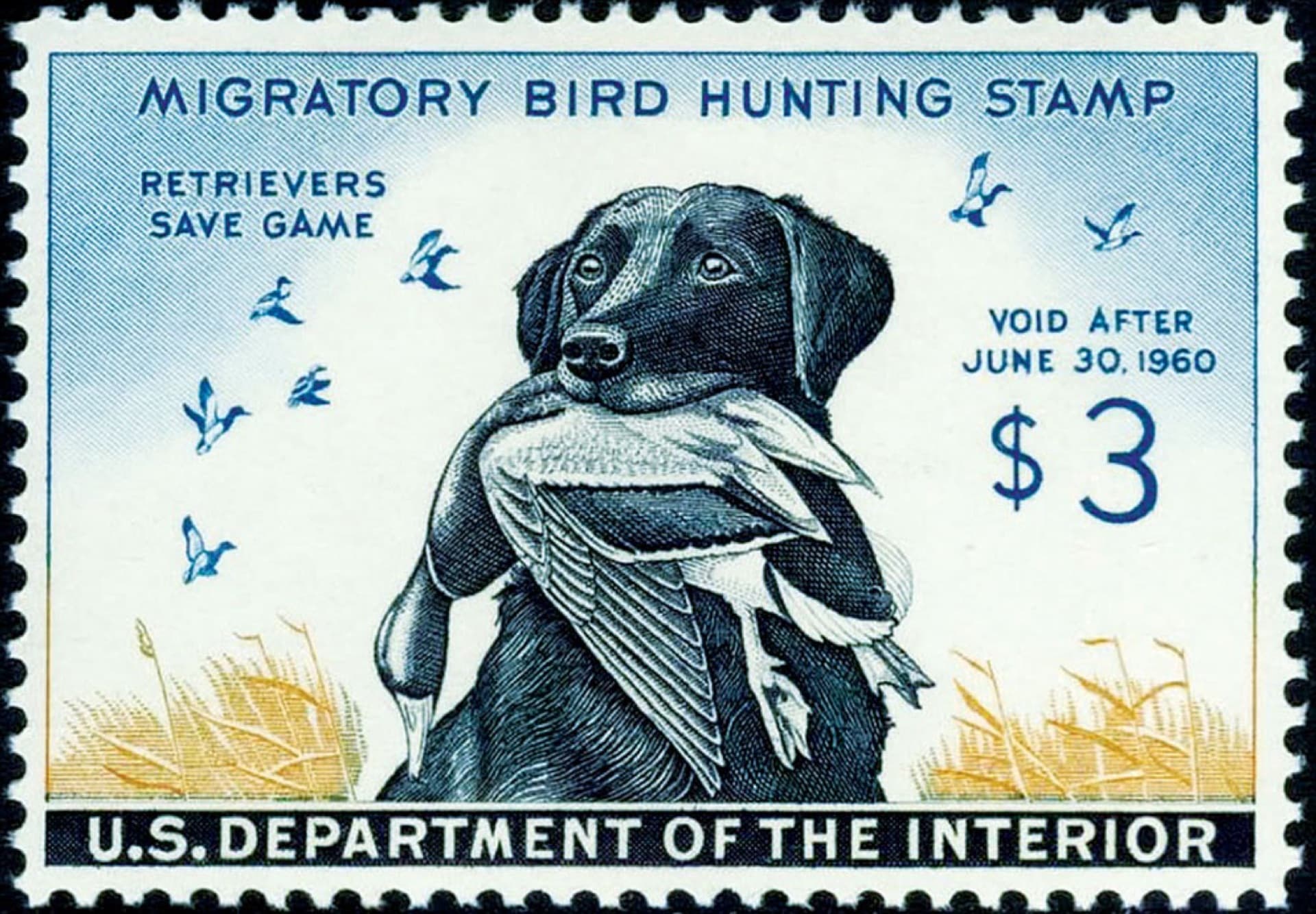
King Buck also enjoys a similarly unique brand of extraordinary performance, records, accolades, and an ability to predictably win which is as relevant today as it was in 1959, when U. S. Fish and Wildlife Service paid tribute to retrievers and their role in waterfowl conservation by requiring the design of the current Migratory Waterfowl Stamp be a retrieving dog at work.
John M. Olin commissioned Maynard Reece, the famous Iowa artist whose work had already appeared on two “duck stamps,” to travel to Nilo Farms and capture this unique brand of National Champion Labrador Retriever. The final composition was breathtaking; a portrait of King Buck with a drake mallard in his mouth, set against a backdrop of windswept marsh grass and flaring ducks. King Buck was entered by Maynard Reece and chosen as the winner. It was the first time a dog ever appeared on a United States stamp.
I own a Maynard Reece and understand the artist’s ability to capture the moment as if you were right there in the scene.
So many firsts, and new never-before-thinking allowed John M. Olin, T.W. “Cotton” Pershall and King Buck to create a new brand for Labrador retrievers, catapulting the AKC breed to the most popular breed in the world.
King Buck died on March 28, 1962, just one week before his fourteenth birthday. He was placed in a small crypt at Nilo Kennels’ entrance, his statue above him…an impressive site worthy of a champion and an unconditional friend. King Buck and John M. Olin both know, the retriever is also buried in his master’s heart, who carries him always and everywhere.